If you’ve ever walked through a pulp and paper mill, the first thing that hits you is the noise—grinders screaming, steam hissing, massive pipelines rumbling with everything from wood chips to slurry, white water, and finished pulp. What you might not hear are the quiet, unassuming Rosemount flow meters tucked into those pipes, working around the clock to keep operations on track. I’ve been a Rosemount flow meter supplier for 12 years, and I can’t tell you how many times mill managers have come to me confused about why their old meters were failing, or why their flow readings were off, leading to wasted raw materials, inconsistent pulp quality, or even unplanned shutdowns. Today, I want to break down exactly how Rosemount’s flow meters work in pulp and paper mills—no jargon, just real-world context you can take back to your operations. Rosemount Flow Meter
First, let’s set the scene: pulp and paper isn’t like a water treatment plant or a refinery. The fluids we handle here are messy. There’s black liquor (a caustic, sludge-like byproduct of cooking wood chips), white water (recycled water mixed with fine fibers), pulp slurry (thick, often 3-6% fiber by weight, sometimes more for later processing), and even steam at extreme temperatures. Generic flow meters often struggle with this because they can’t handle the abrasion of wood fibers, the corrosiveness of chemicals, or the fact that pulp slurry isn’t a uniform liquid—its density shifts from pipe to pipe, even minute to minute. That’s why Rosemount designed its flow meters specifically for these harsh, variable environments.
The most common type we install in pulp and paper mills is the Rosemount 8800 Vortex Flow Meter, and it’s not just another vortex meter. Let’s get into how it works, step by step, for a pulp mill’s main stock line—say, the line that moves pulp from the refiners to the paper machine headbox, where consistency is everything. Vortex flow meters work on a simple principle: when a fluid flows past a bluff body (that’s the perpendicular metal “bar” you see in the meter’s pipe), it creates alternating vortices on either side of the body. The frequency of these vortices is directly proportional to the velocity of the fluid. For pulp slurry, this is a huge win because unlike ultrasonic meters, which can be fooled by bubbles or fiber buildup on transducers, or magnetic meters, which need a conductive fluid (and struggle if pulp consistency drops too low or has air bubbles), vortex meters hold steady even in thick, fiber-laden flows.
Wait, you might be wondering: how does Rosemount’s version differ from a cheap vortex meter you might find at a hardware store? The bluff body is custom-engineered for slurry. Instead of a simple square bar, it’s shaped to minimize fiber accumulation. I’ve seen other vendors’ vortex meters get clogged with pulp within a week—fibers wrap around the bluff body, throw off the vortex frequency, and give false high flow readings. The 8800’s bluff body has a tapered design that lets fibers pass through without catching, and the sensor that picks up the vortices isn’t a delicate wire. It’s a piezoelectric sensor embedded deep in the meter body, protected from direct contact with the slurry. That means less maintenance, which is priceless for a mill where every hour of downtime costs thousands.
Let’s walk through a real installation: a pulp mill I’ve worked with in northern Wisconsin, a few years back, was having issues with their 10-inch stock line. Their old magnetic meter was giving inconsistent readings because air bubbles from the deaerator upstream were messing with the signal—one day they’d be running at 15% consistency, the meter would say 12%, so they’d add extra water, wasting fiber, and the next week it would flip the other way. We swapped in a Rosemount 8800 Vortex Meter, and in the first month, they cut fiber waste by 7% because their consistency readings were accurate to within 0.2%. How’d that happen? The 8800 not only measures vortex frequency for velocity, but it has built-in temperature and pressure sensors too. For pulp slurry, which expands or changes density with temperature and pressure, that data lets the meter automatically correct its calculations, so even if the slurry warms up a bit as it travels from the refiner to the headbox, the flow reading stays right. That’s a feature off-the-shelf vortex meters don’t have.
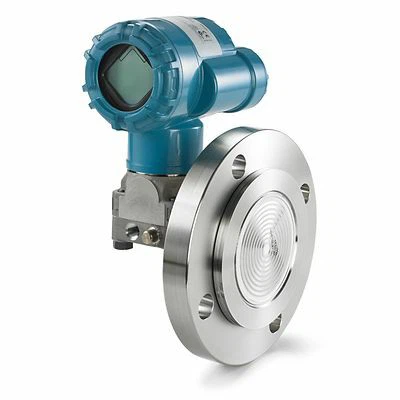
Another key product we see a lot in pulp mills is the Rosemount 3051S Coplanar Pressure Transmitter, paired with an orifice plate or a venturi tube for measuring black liquor flow. Black liquor is super corrosive—it’s a mix of sodium hydroxide, sulfides, and fine carbon from the cooking process, so it eats away at cheap pressure sensors in months. The 3051S has a diaphragm coated with Hastelloy C, a material that can stand up to that caustic sludge for years. How does this work? When you have an orifice plate installed in a pipe, it creates a pressure drop across the plate—higher pressure upstream, lower downstream. The 3051S measures that pressure difference, and using Bernoulli’s equation, calculates the flow rate. For black liquor lines, which often run at 150°C (300°F) and 100+ psi, the 3051S is designed to handle that heat and pressure, and it has a remote seal option so you don’t have to run the transmitter directly in the hot, corrosive black liquor line. That means no frequent replacement of seals, which is a big deal—changing a transmitter on a 12-inch black liquor line requires shutting down the line, which can take 4-6 hours for a mill, not to mention the safety risks of handling caustic chemicals.
I should also mention ultrasonic meters, though they’re less common for high-consistency pulp. Rosemount’s 1400 Series Ultrasonic Flow Meter is used for white water lines and effluent lines, where conductivity is high but you need to measure very low flow rates. Unlike some ultrasonic meters that are prone to fiber buildup on the transducers, the 1400 has a self-cleaning feature—small ultrasonic pulses that vibrate the transducer every few minutes to shake off any fine fibers. I’ve seen mills use these on their wastewater discharge lines to make sure they’re not over-discharging or under-treating, which is critical for environmental compliance. The EPA has strict rules for pulp mill effluent, so accurate flow measurements here can mean avoiding six-figure fines for non-compliance.
Now, let’s talk about the challenges unique to pulp and paper that make Rosemount meters stand out, because that’s the stuff most other suppliers don’t get. One big one is fiber matting. Pulp slurry has long wood fibers, which can build up on the interior of pipes over time, changing the pipe diameter and throwing off flow calculations. Rosemount’s meters, especially the vortex and ultrasonic lines, have diagnostic built-in. The 8800 Vortex can actually detect changes in vibration that signal fiber buildup on the pipe wall, and send an alert to the mill’s control room. So instead of waiting for flow readings to drift 10% and realizing there’s a problem, the maintenance team can do a quick pipe cleaning during a scheduled shutdown, before it becomes a big issue. Another challenge is consistency variation. A paper machine needs pulp at exactly 4% consistency to make uniform paper—too high, and the sheet breaks; too low, and you waste fiber. Rosemount’s meters integrate with the mill’s distributed control system (DCS) in real time, so when the meter reads a consistency shift, it automatically adjusts the flow of water or pulp to get back to the target. That’s not a nice-to-have—it’s how mills reduce their broke rate (the paper that’s rejected and recycled) by up to 5%, according to a 2022 pulp and paper industry study.
I get it, as a supplier, I’m biased, but I’ve installed dozens of these meters, and I’ve seen the difference. Last year, a paper mill in Georgia was using a competitor’s flow meters on their headbox lines, and they were having a 12% broke rate—meaning 12% of their paper got torn up and reused, costing them over $200,000 a month in lost fiber and production time. We swapped out four of their meters with Rosemount 8800 Vortex meters, and within three months, their broke rate dropped to 7%, saving them nearly $120,000 a month. That’s not a sales pitch—that’s numbers from their actual production reports.
So, when you’re evaluating flow meters for your pulp and paper operation, don’t just look at the initial cost. A $5,000 Rosemount meter that lasts 10 years with minimal maintenance is way cheaper than a $2,000 meter that you have to replace every 18 months, plus the downtime costs. And more than that, accurate flow measurements directly impact your product quality, raw material use, and compliance.
If you’re dealing with inconsistent flow readings, frequent meter failures in harsh pulp or chemical lines, or just want to reduce your maintenance and production costs, I’d encourage you to reach out to discuss your specific application. Whether you’re measuring stock flow, black liquor, white water, or effluent, we can recommend the right Rosemount meter, answer any questions, and even provide a site assessment to make sure it’s installed correctly for your mill’s layout.
Yokogawa Temperature Transmitter References
- pulpandpapertech.com. (2022). “Flow Meter Performance in Slurry Applications.” Retrieved from pulpandpapertech.com
- Rosemount. (2021). “Vortex Flow Meters for Pulp and Paper: Application Guide.” Rosemount Inc.
- EPA. (2020). “Pulp and Paper Effluent Compliance Requirements.” U.S. Environmental Protection Agency.
- Miller, R. W. (2018). Flow Measurement Engineering Handbook, 4th Edition. McGraw-Hill Education.
Iges Instrument Co., Ltd.
With abundant experience, we are one of the most professional rosemount flow meter suppliers in China. Please feel free to buy high quality rosemount flow meter in stock here and get quotation from our factory. Good service and low price are available.
Address: No. 103, 1st Floor, Dacheng Commercial Building, Chezhan Avenue, Lucheng District, Wenzhou City
E-mail: igesinst@gmail.com
WebSite: https://www.iges-inst.com/
